

when was the last time you really felt joy?
dimension 4 of 12: what most of us forget while chasing our goals

When was the last time you felt pure, unrestrained joy?
The kind that envelops all of you. Fully. Without hesitation or any hint of control.
For many of my clients, that question begets a blank stare.
Because for many, they can’t remember.
For me, I’ve always been able to find joy. But there were times when it lurked in the shadows, unsure if it should make an appearance.
Responsibility. Success. Productivity.
They stole the spotlight.
And joy stood still, behind the curtain.
Wavering.
Whispering.
“Is it my time to shine?”
And if I’m completely honest, that’s still true quite often.
I find joy in my day-to-day, but I still see responsibility, success, and productivity vying for my attention (I am literally writing this as my 4-month-old naps next to me).
What excites me about today’s dimension isn’t finding the perfect balance (that’s why we have 12 dimensions in lifestyle design), it’s leaning into joy so it can energize you for the other dimensions in your life.
Shall we?

what is joy?
Joy is knowing what brings you joy and then doing those things. Not for money. Not for praise. Or a specific outcome. Not for anyone else. For you.
And you’ll know when you’ve found those things because you’ll experience a deep, sustained sense of contentment and aliveness that arises from within. It's an inexplicable certainty that you're exactly where you need to be.
You’re fully present.
So I’ll ask you again.
And if you’re afraid you’ve missed out on the joy gene, don’t worry.
Joy is inherently part of you.
Within the first six to eight weeks of your life, you experience your first observable expression of joy and connection, a social smile. It’s the first thing you do with another person. And while you might have traded joy for jadedness with life’s trials and tribulations, remember, it’s still there.
It’s a part of you.
It always has been.
joy doesn’t have to be big
A lot of “joy” that’s sold to us is big. A luxurious trip. A fancy meal at a Michelin-star restaurant. A swanky cocktail on a picturesque beach alongside swaying palm trees. Something that requires a substantial financial investment. And while those big things can bring us joy, I’d argue they’re not the ones that truly sustain us.
After my role was impacted during a company-wide layoff, I went from these big “joys” to the small ones.
Waking up slowly.
Watching the sunrise.
Walking on the beach and feeling the sand massage my toes.
A morning cuddle with my husband.
Listening to music, just to listen to music.
Sitting on a bench and people watching.
Chatting with my coffee shop friends.
Surf skating around Poblenou.
And you know what? That joy filled me so much more than I had anticipated.
More than the big joy things.
Now, don’t get me wrong. Flying business class and staying in a nice hotel is fun. But it doesn’t touch what the small joy offers.
Turns out my experience isn’t unique. UC Berkeley’s Greater Good Science Center conducted the Big Joy Project, the largest study of its kind. Between 2022 and 2024, researchers evaluated a one-week program among 17,598 participants across 169 countries. Each day, participants committed to 5–10 minutes of a micro-act of joy.
What did they find?
Measurable gains in emotional wellbeing, positive emotion, happiness agency (= the sense that you can shape your own joy), reduced stress, better self-reported health, and better sleep.
And the greatest gains came from 4 kinds of practices:
Social connection. Consistently identified as one of the single best predictors of joy and wellbeing.
Gratitude. People who practiced it reported higher life satisfaction and optimism. It shifts the brain’s focus “from what’s wrong to what’s right.”
Acts of kindness or prosocial behavior. Increases in joy from helping others predict increases in psychological flourishing (think about that on a nervous system level, too).
Mindful savoring. Being present enough to recognize a good moment.
the awe-someness of joy
Let’s go back to big joy. I want to redefine it. Let’s boot the capitalized version—dropping large amounts of cash—and trade it in for the free version (don’t worry, you can still enjoy the capitalized version from time-to-time).
What does the free version look like?
Awe.
Well, according to Dacher Keltner, UC Berkeley, faculty director of the Greater Good Science Center. In his book Awe: The New Science of Everyday Wonder, he claims that awe may be the direct pathway to joy and meaning.
But, what is awe exactly?
It’s “the feeling of being in the presence of something vast that transcends your current understanding of the world.”

Keltner’s research found 8 ways to evoke a sense of awe:
moral beauty (witnessing others' courage or kindness)
collective effervescence (moving in sync with others)
nature
music
visual design
spirituality
life and death
epiphanies
Though—surprise, surprise—other people’s goodness evoked awe the most often.
So, if you’re not sure where to start. Start with awe. It’s the doorway to joy and meaning (more on meaning in the soul dimension deep dive).
why joy matters
Simple. Joy has its own signature in the body and often feels like coming home to yourself.
Who wouldn’t want to feel like that every day?
Beyond our felt sense, a lot is going on below the surface. Have you ever explored joy through the lens of the nervous system or the infradian rhythm?
Well, that’s what we’re doing now. Geeking out on the science behind joy and how it impacts our bodies.
when joy and the nervous system collide
We often view joy as a feeling. Sure, it is. But it’s also a nervous system state.
Remember the fun fact that ~80% of vagal nerve signals travel from body to brain (only 20% brain to body)?
Well, when the vagus nerve activates the branch that says, “Hey, you’re safe,” it unlocks access to calm, engagement, curiosity, savoring, presence, and yes, joy.
Or the ventral vagal state. What I call the turquoise zone.
But the opposite also applies.
If your nervous system perceives a threat, you lose access. It’s impossible to access joy from a protection state—the blue (freeze or shutdown) or orange (fight or flight / tend and befriend) zones.
Why does this matter?
Because the fastest route to joy is often bottom-up, through the body. Not the mind.
The better you are at returning to turquoise, the more joy you can experience. Pretty cool, right?
joy as an antidote to stress
In nervous system mastery for women, we talk A LOT about stress and our hormones.
Now, what about joy and our hormones?
Imagine taking your four fave ingredients and inventing a lip-puckering, mind-expanding drink. That’s joy. Joy is just a neurochemical cocktail.
And the main ingredients—or neurochemicals—are:
Dopamine. This is less about the pleasure itself, more about the motivation to seek and reinforce the memory of what felt good. It’s the drive to move toward joy again.
Serotonin. Creates steadiness—regulating mood, sleep, and appetite.
Oxytocin. The connection chemical. It also downregulates the HPA axis (the stress axis) and directly counteracts cortisol.
Endorphins. Natural relief and elevation, boosted by movement, laughter, and music.
A pretty magical mix. And more importantly, it's a physiological antidote to chronic stress—ultimately changing the hormones surging in your body.
cycle seeking joy
But what does that mean for all those women with an infradian rhythm?
Joy shifts throughout the month just like your hormones.
How, you ask?
🌺 your inner spring (follicular)
Estrogen rises. That rise boosts dopamine. And that extra dopamine amplifies motivation, reward sensitivity (= good things feel more magnetic and more rewarding), and the drive towards joy.
Estrogen also elevates serotonin synthesis, leading to better mood, cognition, and even pain tolerance.
☀️ your inner summer (ovulation)
When estrogen peaks, so does your joy. Studies found a significant rise in positive moods and a drop in negative ones.
The first half of your cycle becomes another kind of superpower because positive emotions, like joy, broaden what feels possible. So you play, experiment, wander off the path. Joy opens you up.
🍂 your inner autumn (luteal) + ❄️ inner winter (bleeding)
In late luteal when estrogen and progesterone crash and serotonin dips, you might feel more irritability, sensitivity, fatigue, or sadness. In bleeding, energy and motivation tend to run low.
Buuuut, when you care for it, this is an amazing phase to cozy up with the feeling of contentment.
Rest.
Warmth.
Tending.
Going inward.
In these lower-estrogen phases, your window of tolerance narrows, so joy needs more safety and regulation support, not more forcing. But it’s still there. Just a different manifestation.
cultivating generative joy
Fear and stress push you into survival mode, shrinking what you see as possible. Joy widens your perceived possibilities.
Yet, a single moment of joy is fleeting.
It fades.
And that’s okay because the play and exploration it invites leave something behind. Playing builds physical skills and coordination. Exploring builds knowledge. Connecting builds relationships and social support.
And over many small moments, those somethings left behind accumulate into lasting resources to create a good life.
So joy no longer becomes a byproduct of a good life. Instead, it's one of the mechanisms that cultivates it.
It's a generative loop. Kind of like the chicken or egg scenario.

how to generate joy in your life
Before we go into the how, let’s run a quick inventory.
Grab a piece of paper.
Open up notes on your phone.
Write down all of the things that bring you pure joy. Big. Small. Anywhere in between.
Maybe you’ve got loads. Maybe you’ve got a blank page. No matter where you are, it’s exactly where you need to be for the first practice, joy quests.
joy quests
If you know me, you know I love adventures—from video games to travel and geocaches. And adventures, I’ve found, are one of the best ways to rediscover what brings you joy.
Here are the steps in a nutshell:
Reflect on what joy has meant (and still means) to you.
Design your joy quests—cycle-aligned and body-first.
Go on said joy quests.
Identify your unique joy signature.
Integrate your learnings into your everyday.
The cycle-aligned, body-first part is the piece most joy advice skips. Joy runs expansive and playful in your follicular and ovulation weeks, and quieter—cozy, restful, savoring—in your luteal and bleeding phases. When you design your joy quests, alignment is key.
And your joy signature? It’s the pattern you uncover—the conditions that consistently bring you alive. Things like alone or with people? Moving or still? Making something, or soaking something in? Once you know your joy signature, you stop guessing at joy and start designing it intentionally.
(I’ve built the whole quest—reflection, tracking, and signature—into a done-for-you Notion template. More on that at the end.)
joy dimensions in practice
Back to the blank stares. Where do you even begin? Here are places to start:
🧩 Play. Doing things for the sheer delight of them, the way you did as a kid.
🌌 Awe and wonder. The moments that make you feel small in the best way: nature, art, music, or watching someone do something good.
🍵 Savoring. Slowing down enough to sink into a good moment while it’s happening.
✨ Micro-joys. The small, everyday sparks, not just the big ones.
⏳ Flow. The things you love so much, you lose track of time.
🌊 Spontaneity. Leaving room for the unplanned yes, the silly, the impulsive. One of my personal faves!
🎉 Celebration. Recognizing the wins and practicing gratitude.
🌈 Beauty. Noticing and inviting in what pleases your senses, just because.
joy is the dimension that lives in all the others
Joy is one of the coolest dream life dimensions.
It doesn’t exist on its own. It’s woven into every other dimension.
A joyful body.
A joyful mind.
Joyful contribution.
Even joyful wealth.
Which means you can get meta. Take the same dream life design framework you’re using for everything else, and bring joy into each dimension.
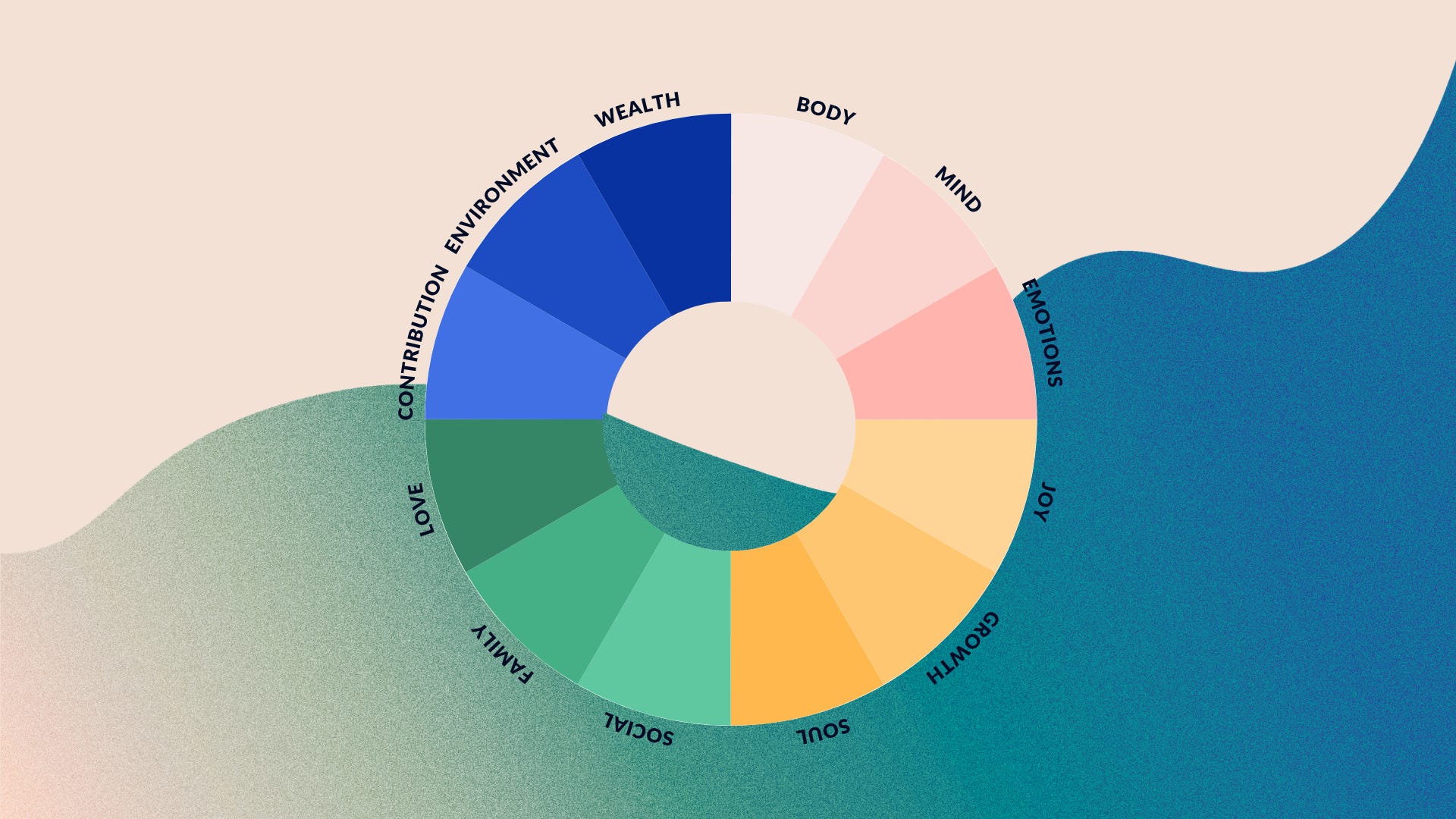
So, instead of asking “when am I happy?” and waiting for an answer to arrive, you envision your dimensions one at a time and ask the same question for each:
Where does joy show up here?
find your joy across all twelve
Ready? Pull up your vision and go dimension by dimension.
Here are some questions to help you explore each dimension outside of joy.
Body. Where’s the joy in how I move, rest, and eat?
Mind. What lights me up to learn, think about, or make?
Emotions. Which feelings do I love letting myself fully feel?
Growth. What energizes me to get better at?
Soul. What makes me feel connected to something bigger than myself?
Social. Who are the people I laugh most freely with?
Family. Which small rituals with my people feel like home?
Love. Where does affection feel playful and loving?
Contribution. What part of my work would I do for free, just for the joy of it?
Environment. Which spaces feel good to be in?
Wealth. What does money buy that brings me joy, not status?
Hopefully, after this exercise, you’ll have found joy wherever it already lives.
notice the ripple
One more thing before you go. Joy runs both ways.
You just went exploring for joy inside each dimension. Now flip it. Take one joy you want more of, and imagine actually giving it to yourself this week. Then notice what shifts with it.
When you’re more joyful, what happens to your mind—your focus, your patience?
How does your body feel? Your work? Your relationships?
You don’t have to act on any of it yet. Just notice how it interconnects. Because you're never designing joy alone—you’re designing a life that sustains you.
my invitation for you
If you’ve read this far, it means you’re already inviting more joy into your life. And who doesn’t love that?
So today’s invitation is to embark on your joy quest. Pick one quest this week, notice where it lands in your body, and what that means for your joy signature.
And if you haven't crafted your vision yet, that's the place to start. Then deepen with the deep dives.
Ready to go on the adventure?
Paid subscribers get the rediscovering joy Notion template—reflection prompts, a joy-quest tracker that logs your energy and where you feel it in your body, the joy-signature exercise, and integration guidance for your everyday. In one week, you'll know your own joy signature, with a joy or two already on your calendar.
As we close today, find your joy. The one lurking in the shadows.
Remind it. It is its time to shine.
It doesn’t mean you have to give up responsibility, success, or productivity. If anything, by inviting joy to be in the spotlight, it will illuminate the others even more.
So, go on. Let it shine ✨
Ciao, ciao for now!

wait! before you go…
a few resources to get started
→ Want to discover your CALM Quotient (CQ)? In 5 minutes, uncover your unique nervous system patterns, the greatest areas of growth opportunity, and one practice to start reclaiming calm. Get your zero-cost CQ here.
→ Want to craft an inspiring vision for your life (and work)? Check out the free vision crafting guide to get started. Download a copy here.
ways to go deeper online and in-person
→ Want to reclaim your calm? Nervous System Mastery for Women is my 6-week cohort to regulate your nervous system, align with your female rhythms, and break free from burnout—in as little as 45 days. Join the waitlist →
→ Want to go deeper, 1:1? I offer private coaching to help high-achievers, leaders, and startup professionals design a life they love from the inside out—career and beyond. Get on the waitlist—coaching spots open August 2026.
→ Want to come together in person? I host in-person retreats. The next one isn’t on the calendar yet, but join the list, and I’ll let you know the moment it opens.
As always, you can find me on YouTube, LinkedIn, and Instagram.