

the first language you were taught to forget
dimension 1 of 12: what your body has been trying to tell you since before you had words

Last week, I walked through Golden Gate Park.
Eucalyptus, crisp and fresh, drifting down from the trees towering over me. Dust rising off the path, ruffled up with each step. A fine, damp mist settling on my skin as Carl the Fog billowed through the branches (yes, we name our fog here lol).


And below the visible, my own body talking.
A heaviness pulling downward in my pelvic floor, still healing months after having Kabir. Yet, at the very same time, something awakening. An energetic release moving up through me with each step, more of me waking up the deeper I walked into the park.
Heaviness and aliveness, in the same breath.
I could feel both.
It was cool because a version of me, not long ago, who would have walked that whole loop and noticed none of it. I had stopped listening years before. Most of us do, eventually. But not one of us started out that way.
That’s what I realized.
You spoke it once, without thinking.
Before you had a single word for it, you knew this language by heart. You cried when you were hungry. You slept when you were tired. You turned away when you’d had enough. You reached when you wanted more.
You didn’t decide to do any of it. You just did it.
It was your first language. And you spoke it effortlessly.
Then, slowly, you were taught to forget it.
Finish your plate, even though you’re full.
Sit still, even though your body wants to move.
Raise your hand and ask permission to use the bathroom.
And into adulthood, be at your desk by 9am, no matter what your body needs.
Little by little, you learned to override the very signals you were born trusting.
I was one of the most practiced forgetters I know.
For years in startups, I didn’t take breaks. I’d stop for a 15-minute lunch, and otherwise I sat. Eight, nine, ten hours at a desk, barely moving.
My jaw stayed tight.
My shoulders rounded forward toward the screen.
The migraines came (and came, and came).
For years, I had them weekly.
I deprioritized exercise.
My sleep was interrupted by 3am thought tornadoes, from all the stress I was accumulating.
My body was talking the entire time. In the only language it had.
I had just gotten exceptionally fluent in not listening.

what is body
This is dimension one of the twelve I use to help women (and myself) design a life they (I) love.
Your physical wellbeing, diet, sleep, and body literacy. I prioritize it for a reason. It’s the foundation everything else builds upon (and most of us have forgotten this foundation).
So today, let's start relearning the language together.
you were born connected
Here’s something that surprised me when I first learned it.
About 80% of the signals traveling along your vagus nerve—the longest nerve that wanders from your brainstem down through your heart, lungs, reproductive system, and gut—move up, from your body to your brain.
Only about 20% travel downward.
Your body isn’t waiting for instructions from your head. It’s the one doing most of the talking, influencing the brain.
There's a name for this skill, interoception.
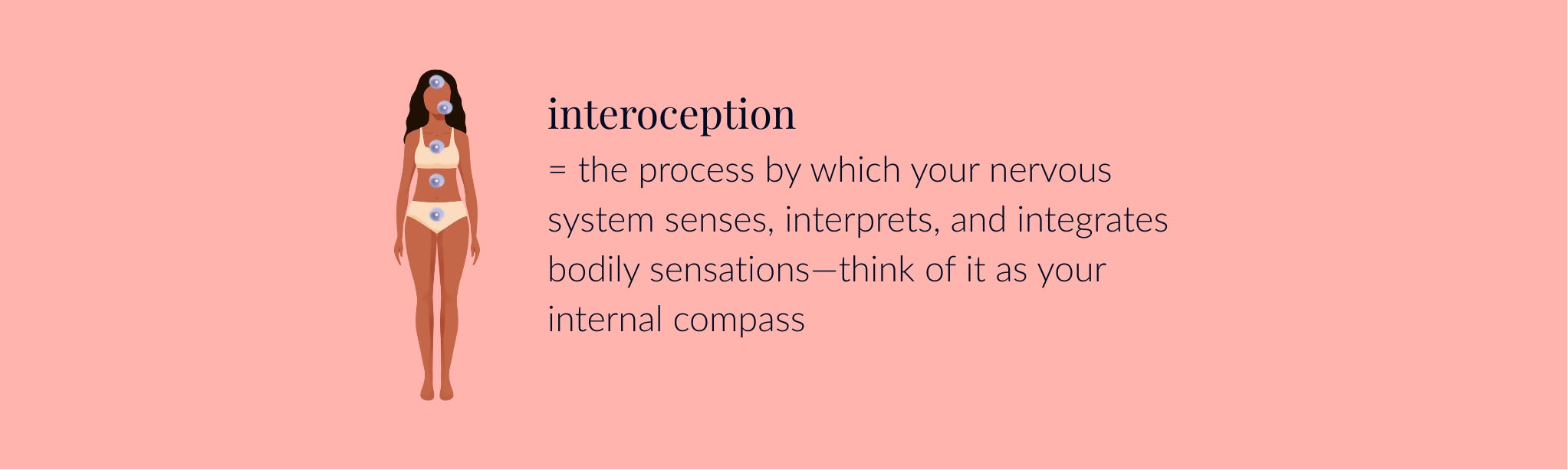
Interoception is your capacity to sense what’s happening inside you. The flutter of your heartbeat. The tightening in your chest. The hunger. The fullness. The buzz of “something’s off” before you can explain why.
Interoception is the vocabulary of your first language. And like any language, it gets easier the more you use it, and harder the more you don’t.
stages of cultivating your interoception skills
Most of us were raised not to practice interoception. Instead, push through.
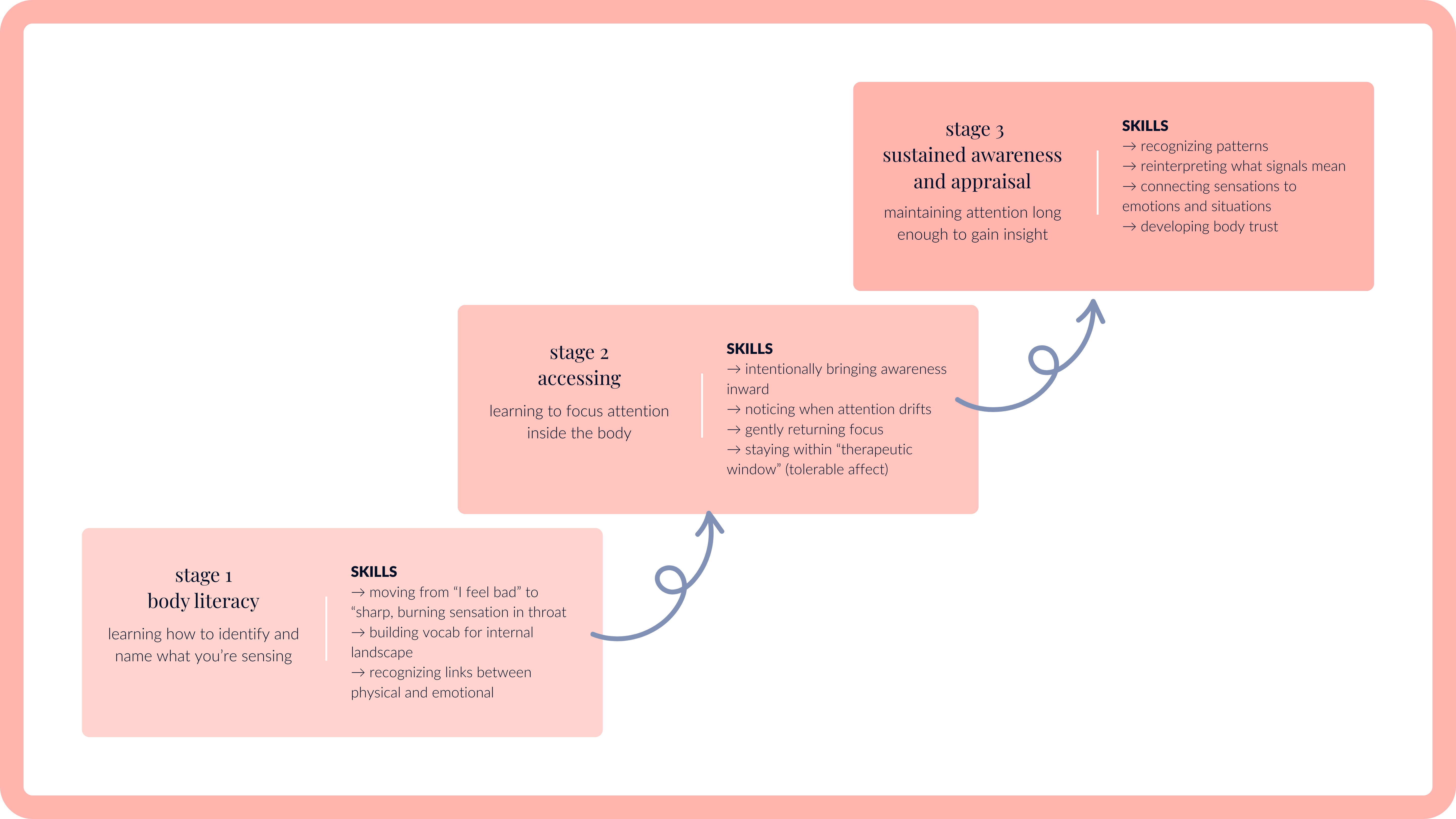
So our way back to listening to the body moves through three stages:
body literacy
accessing
sustained awareness and appraisal
Pause. Take a breath. And notice.
What’s your relationship with your body right now?
Not what you think it should be. What it actually is. Do you turn toward it, or mostly ignore it?
If you’re not sure, that’s okay too. Not knowing is exactly where the relearning begins.
why it matters
how we’re taught to forget
The practice of forgetting doesn’t stop when childhood does. Work amplifies it.
When I think back to my startup years again, what was almost always present? A tight jaw. Migraines. Nightly insomnia. High-functioning anxiety vibrating in my chest. My body keeping score.
How does this work, exactly?
Well, your nervous system can’t tell the difference between a physical threat and a psychological one. A snarky emails activates the nervous system the same way a bear chasing you would. The body floods with cortisol, quickens the breath, tenses the muscles, and pulls energy away from digestion—giving you what you need to flee or fight.
When this happens, the nervous system leaves what I call the turquoise state—calm, safe, connected, the place where you feel most like yourself—and moves into orange. Fight or flight, on high alert. Push hard enough for long enough, and some of us drop into blue—shutdown, numb, burnt out.
(New here? That’s the shorthand I use all through my work. Turquoise for connected and regulated, orange for fight and flight, blue for freeze or shutdown.)
Our stress response is meant to be temporary.
Spike.
Meet the challenge
Recover.
Sprint, then rest.
But a startup doesn’t work in sprints. It’s wave after wave after wave. One fire out, the next one already lit (if not multiple at once). You catch your breath for a second, and you’re never fully able to recover before the next wave.
When that goes on long enough, the wear starts to accumulate in the body. Researchers call it allostatic load—the cost of a stress response that never fully switches off.
It shows up as the clenched jaw.
The rounded shoulders.
The migraines.
The fleeing sleep.
The exhaustion a weekend doesn’t fix.
Increased cellular aging (yes, you’ll get older faster).
And there’s one signal we’re taught to override more than almost any other.
The infradian rhythm, or what you might know as the menstrual cycle.
You cramp, and you show up to school anyway. You bleed through the worst of it, and you’re at your desk by 9am. We learn early that the monthly bleed is something to hide, to power through, to ignore. And the moment you feel a little more, or say a little less, you might be on the receiving end of a sexist comment.
So we push.
We override.
To prove we are equals.
We keep the two lives split—work over here, body over there—and we trust the wall between them to hold.
Well, it doesn’t, my friend.
I don’t have two lives, one for work and one for everything else. I have one. The stress from my desk never stayed at my desk. It followed me into my home life, taunted me in my sleep, and woke up with me in the morning.
Not sure how it impacts you? Try this with me.
Imagine your average workday and walk through it in your mind—waking up, opening your laptop, the meetings, the messages, etc. As you move through it, notice what surfaces in the body.
Where do the sensations live—the jaw, shoulders, stomach, chest, or somewhere else? What quality do they have? Whatever you find—or don’t find yet—is valuable information.
the seasons in your month
Let’s go deeper with the infradian rhythm, because it points to something even bigger.
Most of what you've heard about managing stress was built around a body that runs on a roughly 24-hour clock, more or less the same every day. And you do have that daily rhythm—the circadian one.
But if you’re of reproductive age (and a female), you’re also running a second, longer rhythm underneath it—the infradian rhythm, about 28 days.
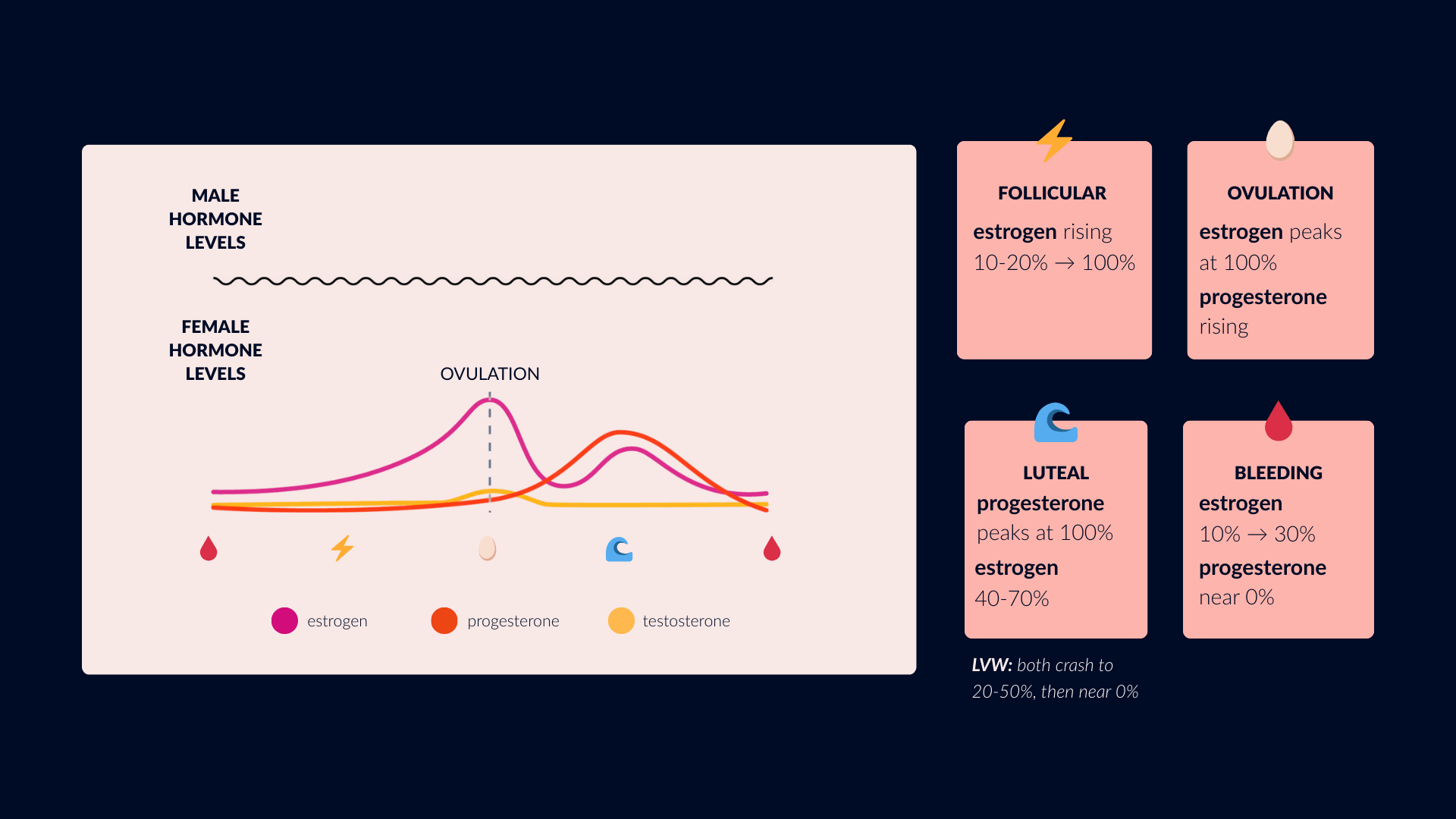
Across the month, your hormones shift, and so does your nervous system’s capacity to handle stress. Your window of tolerance (WoT), how much you can hold before you tip up into orange or drop down into blue, is wider in some phases and narrower in others.
In the first half of your cycle, folicular and ovulatory phases, the WoT tends to be wider. It’s easier to stay in the turquoise zone.
In the second half, your luteal and bleeding phases, the window narrows. Meaning, you’re feeling more of everything.
The body is running two systems at once.
The fast electrical one (your nervous system) and the slower chemical one (your hormones), and in the luteal and bleeding phases, they’re asking more of each other.
how your hormones impact your nervous system
I like to think of it as seasons. You’re the same landscape underneath—what changes is the season moving through you, week to week.
So the same stressful week can feel doable on day 9 and completely undoable on day 24.
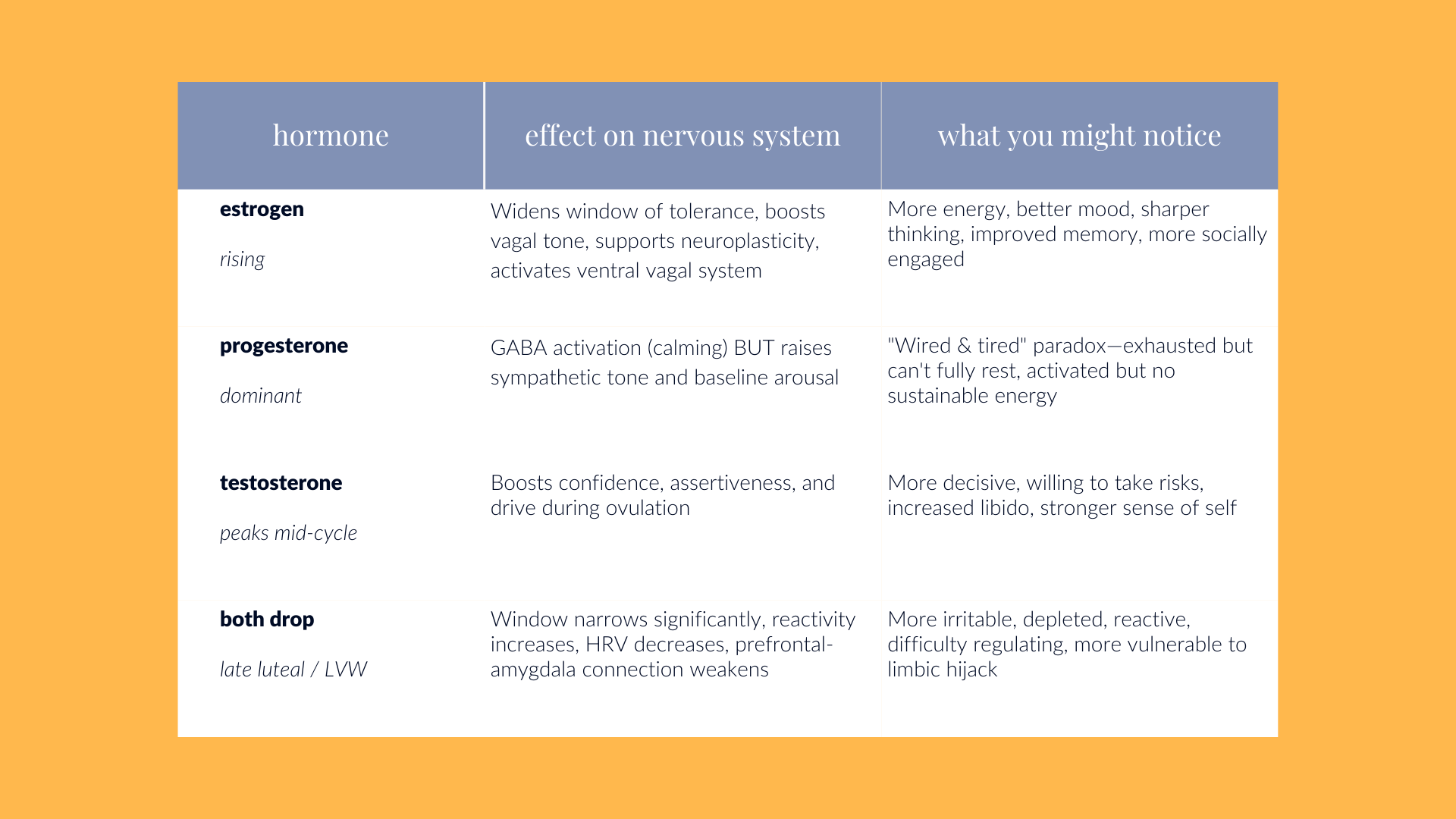
This is the part I could talk about for hours, and it’s the heart of my work in nervous system mastery for women. For now, this is the takeaway…
Your body was never a flat, 24-hour machine. It has seasons. And it’s been asking you to align with them.
Before we move on, a quick check-in…
Where are you in your cycle today?
Notice whether your capacity this week matches what you'd expect—wider and steadier, or narrower and more sensitive. There's no right or wrong. It's just information.
pull one thread, and everything moves
Here’s why body comes first.
The 12 dimensions work as one system—pull one thread and the others move with it. And no thread pulls harder than the body.
When the body is depleted, the mind goes foggy.
Focus slips.
Memory dissolves.
Emotions are overwhelming and take longer to settle.
Your contribution dimension—maybe your work—gets harder to do well, because you’re doing it from depletion.
Even love and social dimensions feel it, because a dysregulated body has less to give the people it wants to be close to (and can even dysregulate others).
I’ve witnessed women try to fix the wrong dimension for years.
Optimizing their calendar.
Changing jobs (hell, that was me).
Reinventing their relationships.
The reality? The root cause was a body that hadn’t felt safe or rested in a decade.
You can’t think your way to a life you love from a body that’s still bracing. Or burnt out. Or in overdrive.
So, we start with the body. Always.
the first step you can take
A solid baseline. Imagine feeling calm, clear, and energized.
Sounds wonderful, right?
It is. But first, you need to find your way back. How, you ask?
relearning your first language
You relearn your first language the same way you’d relearn any language you once knew.
A little every day, at the same time, in the same way—until your body trusts that you’re listening again.
The practice I teach first is the one I use every morning. I call it the CALM practice, and it’s a structured way to check in with the inside of your body. CALM stands for Check-in, Attend, Locate, Map.
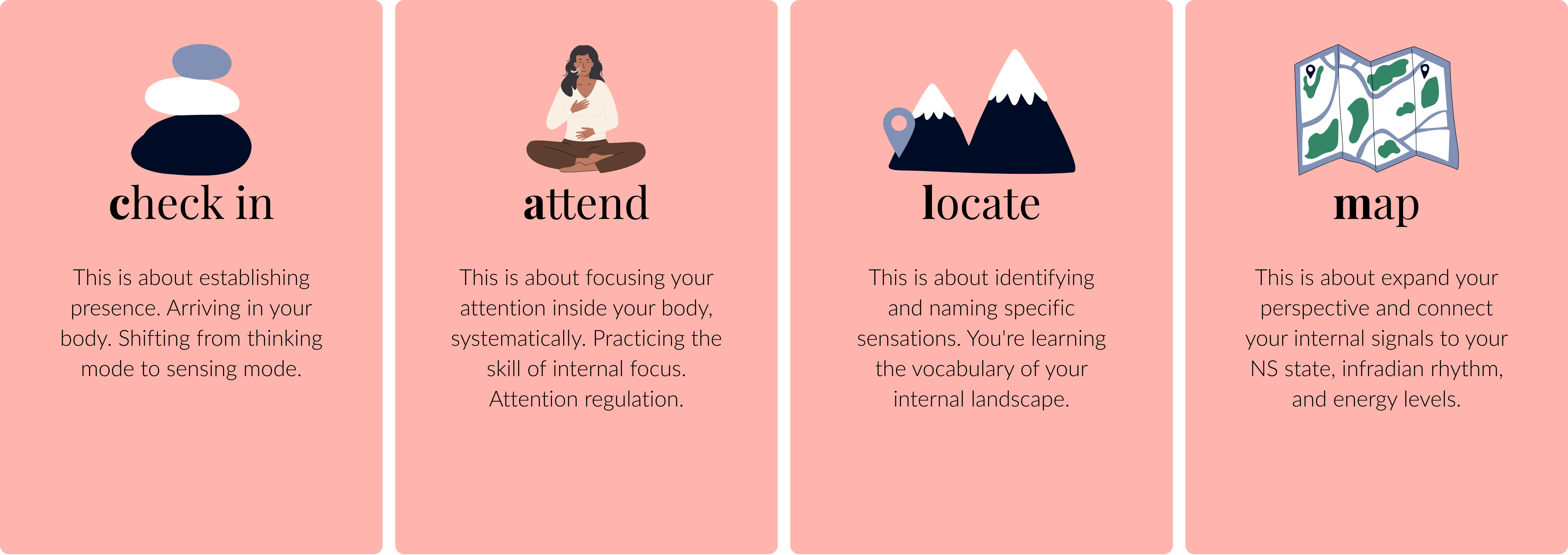
I do it in the morning before the day has affected my nervous system. It’s at its most neutral upon waking—so I get a better read on the day’s baseline.
Here’s what it looks like:
c | check-in
Notice the breath without changing it.
Feel where the body meets the surface underneath you. Arrive.
You’re shifting out of thinking and into sensing.
a | attend
Slowly scan the body, region by region, head to toe. No judgment, just noticing.
Notice posture, physical sensations, and energy.
Your attention will wander. Everyone’s does. Gently bring it back (that returning is the practice).
l | locate
Find where a sensation is most present, and name it with specificity.
Is it tight, warm, heavy? How big is it? Is it moving or still?
This is how you rebuild the vocabulary, one word at a time.
m | map
Zoom out.
What zone am I in—turquoise, orange, or blue? Where am I in my cycle? Does this make sense for that phase? Lastly, “What do I need today?”
Try it right now, before you read on.
And if you’re finding the answer is, “I don’t feel much,” that’s normal! Absence is its own kind of data. You’re not behind.
Two things to help you go further, when you’re ready:
→ Discover your CALM Quotient (CQ). In 5 minutes, uncover your unique nervous system patterns, the greatest areas of growth opportunity, and one practice to start cultivating
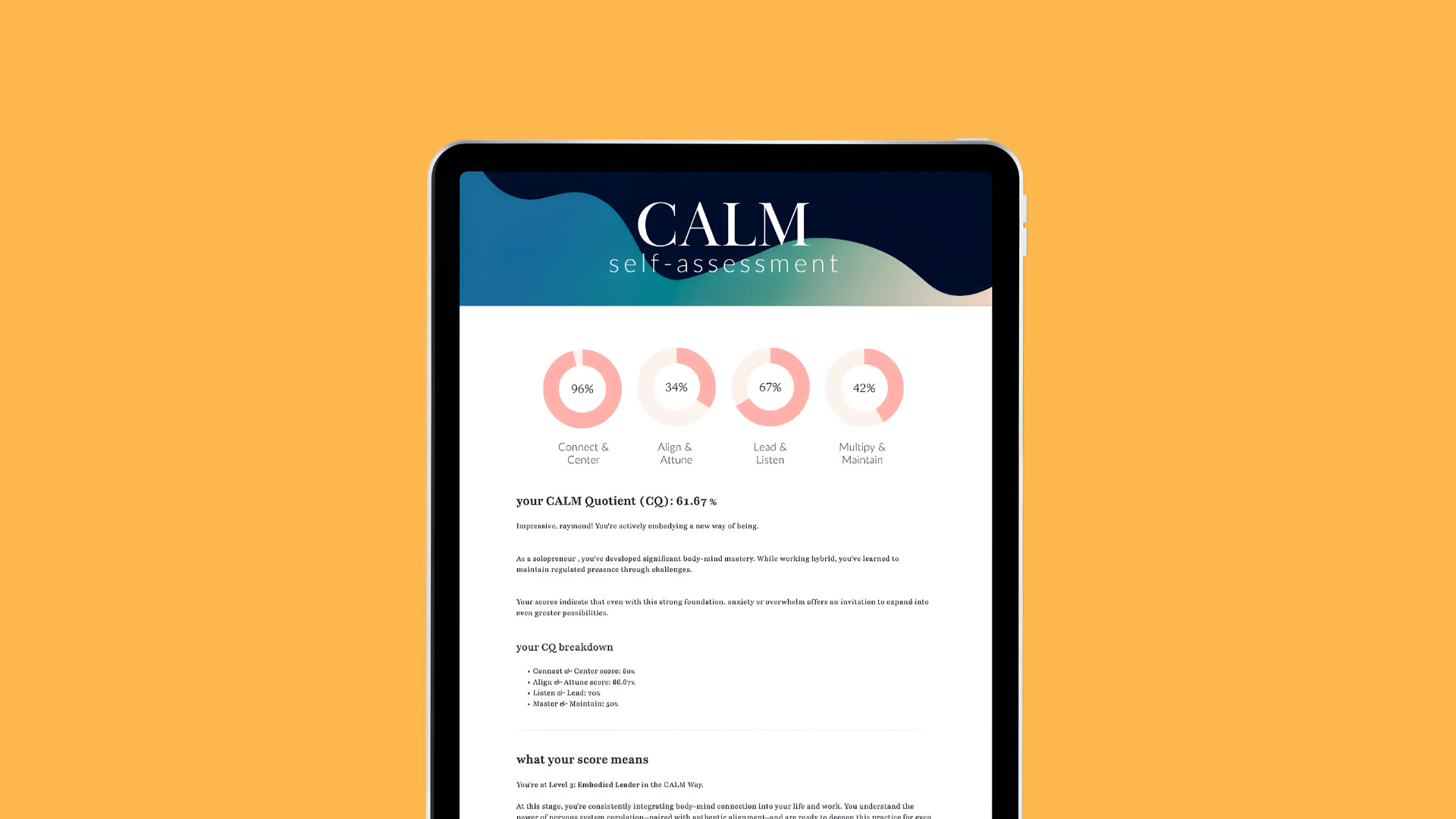
→ Paid subscribers get the guided audio CALM practice. It includes a 13-minute full practice and a 5-minute express practice (recorded by yours truly 😉).
the body dimension in practice
When you sit down to design this dimension, it can feel enormous! Here are a few ways you can dream up the body dimension:
🛌 Sleep — not just the hours, but how rested you feel when you wake up.
🧗🏾♀️ Movement — the kind you enjoy, not the kind that feels like punishment.
🥗 Nourishment — how you eat, what you eat, and intuitive eating.
⚡️ Energy — where it’s high, where it dips, and how it shifts across your day/month.
💗 Rest and recovery — real pauses to care for your body.
🫀Physical health — the checkups, the aches, how your body feels.
☕️ What you take in — caffeine, alcohol, screens, and their impact.
🩸Your cycle — how you honor it vs. override it.
🫂 Pleasure and touch — comfort, sensuality, simply being in a body that feels good.
🧘🏽♀️ Body literacy — the practice we just walked through, reading your own signals.
You don’t have to include every single thing on this list. Notice which ones excited you most as you read through them. Start there. You can always change it as you go.
notice the ripple
Everything’s connected. Pull one thread, and the whole system shifts. So before you go, feel where your thread pulls.
Take one area of body to focus on, and imagine how it’d impact another dimension. For example:
When your body is rested, what happens to your mind—your focus, your clarity?
When you have moved and eaten well, how do your emotions change?
When them body feels safe, what opens up in your contribution/work, relationships, or joy?
You don’t have to act on any of it yet. Just notice how they work together.
my invitation for you
If you’ve read this far, your body brought you here. So let’s honor that.
Here’s my one invitation. Before you try to redesign anything, come back to this dimension first. Not to fix it. Just to feel it. To say hello to a language you’ve known since before you had words.
And if you haven’t crafted your vision yet, that’s the natural place to begin—start there, then come back to this piece and notice how each part of that dream life feels in your body.
The two are meant to complement each other.
As we come to a close, take a breath. Scan from head to toe one more time.
What do you notice now that you didn’t at the start? Where did something soften? Where is it still holding on?
Whatever you found, even if it’s nothing yet, is exactly where you’re meant to be. 💗
Ciao, ciao for now!


before you go…
→ Want to discover your CALM Quotient (CQ)? In 5 minutes, uncover your unique nervous system patterns, the greatest areas of growth opportunity, and one practice to start reclaiming calm. Get your zero-cost CQ here.
→ Want to craft an inspiring vision for your life (and work)? Check out the free vision crafting guide to get started. Download a copy here.
→ Want to reclaim your calm? Nervous System Mastery for Women is my 6-week cohort to regulate your nervous system, align with your female rhythms, and break free from burnout—in as little as 45 days. Join the waitlist →
→ Want to go deeper, 1:1? I offer private coaching to help high-achievers, leaders, and startup professionals design a life they love from the inside out—career and beyond. Get on the waitlist—coaching spots open August 2026.
→ Want to bring this to your team? I help remote companies build people-first cultures where people (and company) thrive, not just perform. DM me for more info.
→ Want to come together in person? I host in-person retreats. The next one isn’t on the calendar yet, but join the list, and I’ll let you know the moment it opens.
As always, you can find me on YouTube, LinkedIn, and Instagram.